
Art Gallery Shows on Peaks: Summer 2026
Peaks Island has 12 miles of trails, on paved and dirt road and through woods and marshes. A little hike is the best way to see many of the sights. Portland Trails and the Peaks Island Environmental Action Team have published some trails.
The Peaks Island “Loop:” https://www.trails.org/trail/peaks-island-loop/
PEAT Naturalist Tour: https://greenerpeaks.org/naturalist-tour
You could also check out the Wander Peaks Island Audio Tour: www.wanderaudiotours.com
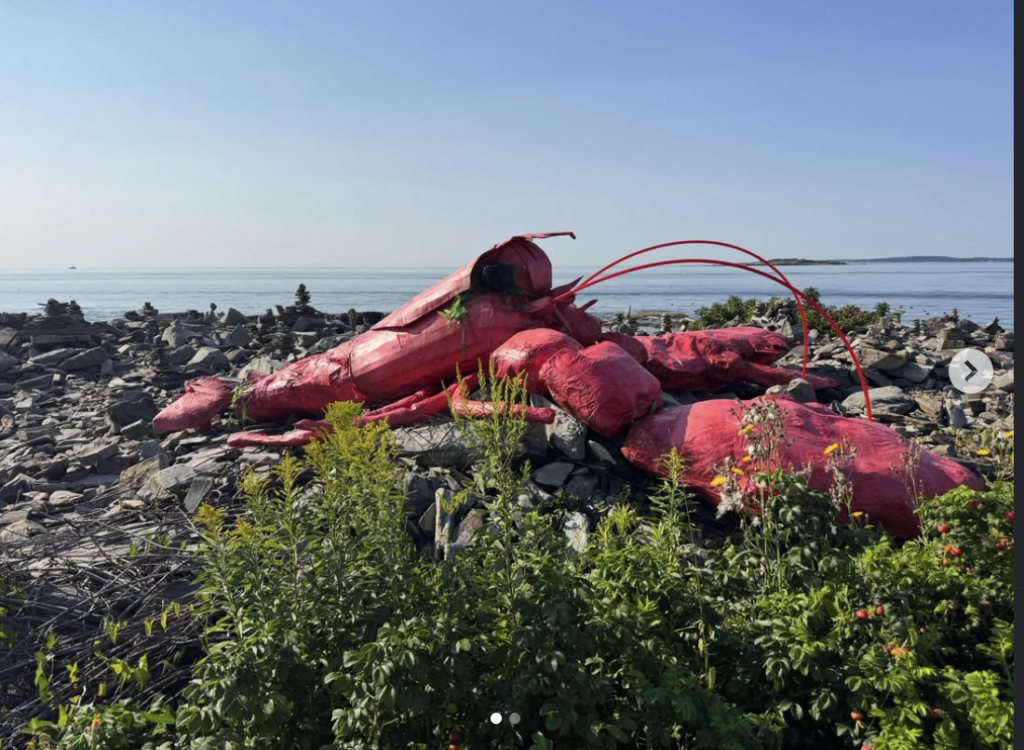
Larry the Lobster visited Maine in August 2026. Did you catch Larry the Lobster visiting Peaks! 

Larry is hard to miss – he’s a 21-foot papier-mâché sculpture created by Dustine Harper-Fahey’s talented art students from Albert Einstein High School in Maryland. He made his grand journey to Peaks by trailer in late July, and made the rounds and struck poses all over the island. You can see some photos here:
https://www.instagram.com/larrythelobsterr26
Here he is on the backshore:
https://www.peaksislandlandpreserve.org/blog/osprey?mc_cid=1d67ea6f0d&mc_eid=50402bee87
Introduction:
This blog is an extension of Peaks Island Newspaper’s article on Ospreys that focused on the its yearly lifecycle. Here we will focus more on the Osprey’s biology.
First, we want to share the history of Peaks Island’s Ospreys in Diamond Pass. This nest is located at the end of Jack Soley’s dock, atop a kayak! Jack’s story (as summarized by Ben), inspired us to write about these unique birds:
“A nesting pair has taken up residence at the end of Jack’s dock for the past four seasons. In the first year, the mother laid one egg, but the nest was poorly constructed and fell, shattering the egg. Prior to Year 2, Jack built a nesting platform for the pair, and they returned to hatch one chick. Jack also added sticks to the platform, but the ospreys discarded them in favor of gathering their own sticks.(lol) Year 3, there were three chicks, but only two survived after a suspected case of fratricide. This year, there are three chicks. So far, so good.”
About Ospreys:
The Osprey is essentially a hawk (Order Accipitriformes; Family Pandionidae; Pandion haliaetus) specializing in eating fish (a piscivorous bird of prey) and found on all continents except Antarctica.
Biology:
Plumages are similar between the male and female with striking white bellies with a mottled brown breast band – and dark wings and back. The female is usually a little larger than the male. This ‘fish hawk’ has changed little from 10-15 million years ago and is unique as the only species in Family Pandionidae. The Osprey’s wings are long and narrow allowing for hovering and maneuverable flight. Although not a soaring bird as other hawks, the Osprey can soar especially during afternoon updrafts. During long migration flights the Osprey does not soar but uses only direct sustained flight (powerful wingbeats).
The Osprey’s head is narrow and lacks the bony ridges (supraorbital ridges) above the eyes, as in hawks and eagles. Without this ridge the Ospreys lack the ‘fierce’ look of other raptors. These ridges in other hawks and eagles may have two functions:
1. Aid in distributing mechanical stress while eating tough foods. The Osprey’s diet of fish is not as tough as eating mammalian skin, flesh, and bones.
2. They protect the eyes when flying through forests and thick vegetation. Ospreys do not usually fly through forests or bushes.
Several evolutionary adaptations give Ospreys a unique title in the bird world as a fish specialist. As a raptor, it has 3 toes forward and one toe in the back. But, wait, there is more – the outer front toe is reversible – it actually swivels backward. In an instant the Osprey can change its toe orientation: Two toes forward, two toes backward (*zygodactyl orientation of toes). These toes with razor sharp talons are also long and very curved. Foot pads are spiny. These 3 features allow for clenching slippery slimy fish. In addition to its unique toes, this buoyant bird’s long legs allow it to reach for fish up to a meter into the water.
The Osprey’s version of wearing goggles include nasal valves that close during a dive, preventing water from going into their nostrils and a third eyelid (nictitating membrane) that also closes while underwater.
Their preening gland has a high output of preen oil, making their feathers very oily and waterproof after a plunge…no waterlogged feathers. And their intestines are small and long for better digestion of fish and their bones. These amazing evolutionary adaptations have changed little over millions of years.
(*Worth noting – parrots have zygodactyl orientation of their toes. They can easily cling-to and maneuver easily through tropical tree branches.)
Hunting:
Ospreys generally hunt alone, in the early morning and late afternoon, in search of one of their favorite New England fish: winter flounder, menhaden, and pollock. They actively search for prey instead of ‘sit-and-wait’ for a fish while on a branch. They hover over the water and may circle back to verify the location of a spotted fish. After this verification, if there is no fish the Osprey moves-on. Upon a confirmed ‘spotting’ of a fish, the Osprey plunges downward from as high as 90 feet high, at more than 40 miles an hour. While falling steeply, with tucked-wings, it may still maneuver using its wings and tail to keep on track with the target, taking into account that water refracts light – possibly distorting the fish’s location. Before hitting the water, the wings are thrown backward, suddenly un-tucked. Then the feet swing forward before the strike.
Alternately the Osprey may drop down in stages before making a final plunge or it may veer off. Either way after one of these plunge dives, it may rest on the water, securing its fish. With a thrust of exertion and powerful-arched wing strokes (using its outer flexible wing) it lifts off the water carrying a fish that is as heavy as 10-50% of the Osprey’s body mass. Meanwhile the fish is further secured and manipulated, using its now zygodactyl-toe arrangement, carrying the fish headfirst. In midair, with vigorous twists in the air, the Osprey will shake off water from its well-oiled plumage. Once in the air, the fish’s head-first direction, provides hydrodynamic streamlining to reduce aerodynamic drag. This unique bird outshines any of the Bald Eagle’s fishing strategies.
On occasion, avoiding the big plunge, the Osprey will swoop down over the water’s surface – easily snatching a fish.
Breeding
Breeding habitats – array of coastal habitats, lakes, marshes, reservoirs, bay and seashores and sometimes rivers. However, the Osprey’s need for shallow water fishing, does narrow its selection of nesting sites within these habitats.
The Osprey ‘s bulky stick nest requires substantial support (as noted by Jack), and a predatory free site such as sturdy shoreline trees. However, trees are easily climbed by ground predators. Offshore buoys, channel markers, and other artificial platforms (e.g. elevated kayaks) provide safety from ground predators, but are easy target to potential predation by Bald Eagles and owls. However, if eagles are nesting nearby, Ospreys usually will go elsewhere. Evidently, the Ospreys on Peaks Island and House Island chose to stick it out with a nearby eagle’s nest. Jim and Emily have watched Jack’s Ospreys and eagles in elaborate flight displays.
Nests can be constructed of large twigs, seaweed, driftwood, and an assortment of unwanted human treasures which in some cases are harmful to the young. Nests are frequently used year after year, adding new material throughout the breeding season. Some nests become huge – up to two meters deep and up to 400 pounds.
Ospreys can be solitary or form loose colonies which is unusual for a raptor. Because Ospreys are a fish-eating bird, though, they do not need to defend a hunting territory around them. Fish are a mobile resource. They generally tolerate each other.
However, they will intensely defend their nest site by any rogue Osprey intruder or other predatory bird. Initially while still standing guard on the nest, the Osprey will give warnings such as ‘guard calls’ (slow whistle notes falling in pitch sounding like tea kettle taken) and body posturing: an erect stance, back feathers raised, and beating wings. Upon closer approach of an intruder, an intensified ‘wavering call’ is made, changing to an ‘alarm call’ – a high-pitched squeal. To avoid encounters at the nest site where eggs or chicks may be lost, an aerial chase may ensue by striking each other in mid-air resulting in grappling and falling to the ground. More encounters occur where nests are in close proximity to each other such as Peaks Island and House Island nests – as observed by Emily and Jim.
Male ‘courtship calls’ are like the ‘alarm call’ – a high pitched squeal. However, the female will only mate with the male if he brings her fish. Young pairs may not copulate successfully because the male has yet to learn to share his fish with the female, therefore she will not acknowledge him.
After a successful courtship, the female lays from 2-4 eggs, being laid 1-2 days apart. Both sexes incubate although the female does more time at the nests. Hatching occurs in approximately 40 days. The first two eggs are generally larger than the 3rd and 4th, and they hatch earlier giving them advantages over the young siblings. If food is scarce the older chicks will fight for access to the female providing food.
Once there are fledglings in the nest, the male will spend up to 3 hours a day finding food for the female, young, and himself. He generally feeds himself first, before delivering a partial eaten fish to the female. ‘Begging calls’ by the female are used during courtship, when hungry, and for feeding the nestlings. These ‘begging calls’ may stimulate the males to hunt for fish. Sometimes he will ignore her call, however, since the ‘nestling call’ is similar, it is hard for the male to ignore them.
Migration
Not all Ospreys are migrants, only those that breed in the North where winter freezes drive fish to deeper waters. Resident populations in southern states stay near their nest sites during the non-breeding season. Migrants and resident populations do not usually intermingle. Flying alone each bird may reach wintering grounds in the West Indies, Central America, and South America in less than a month, although the young birds may take longer. We are familiar with their lifestyles here in New England, but what is their lifestyle in their non-breeding habitats. Are they in groups or alone. We do know that breeding partners do not migrate together. They hopefully find each other once they are back in their breeding territories. However, the male may be more loyal to his nest site, than his mate.
References:
1. Birds of the World. Cornell Lab of Ornithology. Online.
2. del Hoyo, J., Elliott, A. & Sargatal, J. eds. (1994). Handbook of the Birds of the World. Vol. 2. New World Vultures to Guineafowl. Lynx Edicions, Barcelona.
3. Gessner, D. (2026). Audubon Magazine. Hunger Pains. Vol 128; # 2. Pp. 20-27.
4. Bellincampi, Suzan. (Spring 2026). Blue Dot Living Magazine. Osprey Comeback. Pp. 40-47. Martha’s Vineyard.
By Patty (and photo) and Sam Wainright, and Ben McCanna.
Thank you Jack, Emily, and Jim for sharing your valuable observations of your ‘backyard’ dock/kayak nesting Ospreys.
by Stephen “Dookie” Fox, Fifth Maine Museum staff
After the Civil War ended in 1865, the Union Army sent a detachment of the 1st United
States Colored Troops (USCT) under Captain James M. Moore, Assistant Quartermaster to
the U.S. Army to Andersonville Prison, to catalogue the dead. Andersonville was a
notorious Confederate-run prison in Georgia where Union prisoners-of-war were sent.
Moore was fortunate to meet up with Clara Barton and Dorance Atwater.
Atwater had been a prisoner at Andersonville, and served as clerk for Doctor Isaiah
White, Surgeon in Charge of the prison. One of his jobs had been to catalog the dead.
Paroled in February of 1865, Atwater returned home to Connecticut. Unbeknownst to the
Confederates, Atwater created a duplicate list of the dead that he kept hidden. It was from
this list that helped Moore and Barton identify the dead and bury them in marked graves.
The list, though containing some errors, is the most complete and accurate roster of those
that perished in the horrible conditions of Andersonville. It lists the fallen by state, and
includes men from all branches of service, all Union and Border states, and even some
from Confederate states.
Six men of the 5th Maine gave their lives for the cause, not in battle, but from the
conditions in Andersonville. They were buried on site in numbered graves, at what is now
known as the Andersonville National Cemetery. Fortunately, they are remembered, as they
are memorialized in their respective company windows in our Memorial Hall. They are:
1) Enoch M. Brown, Company G. Believed captured near Bristoe Station, V A on
September 15, 1863. Died March 31, 1864. Buried in grave 269.
2) William Connolly/Connoly (listed as Conley). Company F. Captured at the Battle
of Chancellorsville on May 3, 1863. Died September 6, 1864. Buried in grave 8037.
3) George Devine (listed as Dunnie). Company G. Captured at the Battle of
Chancellorsville on May 3, 1863. Died August 29, 1864. Buried in grave 7240.
4) Sergeant Thomas Spencer Peabody. Company I. Captured near Rapidan River /
Wilderness on December 14, 1863. Died June 20, 1864. Buried in grave 2272.
5) Private Miles (also Milo) C. Walker. Company I. Captured at the Battle of Chancellorsville
on May 3, 1863. Died July 24, 1864. Buried in grave 3894.
6) Private (Corporal) Alanson M. Whitman (listed as Whiteman). Company I . Captured
near Rapidan River / Wilderness on December 14, 1863. Died August 2, 1864. Buried in
grave 4559.
We thank them for their sacrifice.
Posted May 21, 2025
Rate Change Effective June 21, 2025
The CBITD Board of Directors approved a rate change in May 2025 that will take effect on Saturday, June 21, 2025. Here are the important details all passengers should review ahead of June 21st:
| New Fare Types | Peak Season Rate | Off-Peak Season Rate |
| 90-Day Pass w/ Vehicle Add-On (Adult)+ | $194 | $146 |
| 90-Day Pass w/ Vehicle Add-On (Senior/Child/Disabled)+ | $97 | $73 |
+ New Fare types are not available for purchase until Saturday, June 21, 2025.
A summarized rate table is presented below.
Please pass along any questions or feedback to .moc.senilyabocsac@egnahcetar
May 21, 2025
Notice is hereby given that, effective June 21, 2025, Casco Bay Island Transit District is implementing major changes in non-commercial and commercial vehicle rates to Peaks Island.
New non-commercial vehicle rates are as follows:
| General Rate | Peak Season | Off-Peak Season |
| Passenger Vehicle SUN-WED | $150.00 | $70.00 |
| Passenger Vehicle THURS-SAT | $170.00 | $100.00 |
| Passholder Rate* | Peak Season | Off-Peak Season |
| Passenger Vehicle SUN-WED | $46.00 | $46.00 |
| Passenger Vehicle THURS-SAT | $82.65 | $46.00 |
| Handicap Vehicle | $46.00 | $46.00 |
*Annual Pass holders are eligible to purchase Passholder Rate vehicle tickets. 90-Day Pass holders may purchase a Vehicle Add-On at the time of pass purchase. 90-Day Pass holders with the Vehicle Add-On may purchase Passholder Rate vehicle tickets.
*Handicap rate requires proof of handicap plate or placard
2. You can also reserve the Peaks Island Community Center for a community event and any rental by going to the City of Portland Parks/Recreation Online Version at:
City of Portland Parks and Recreation-Community Pass Catalog
Thinking of having your Wedding on Peaks Island?
Peaks Island, ME is a popular site for weddings. But an Island wedding has its complications, and logistics that can add costs.
Venues
While many brides yearn for a beach wedding, beach access on Peaks is limited. See https://peaksisland.info/peaks-island-beaches/
TEIA hosts weddings at their historic wooden “casino” on a beach. Most brides chose the lawn for a ceremony, with a splendid view. TEIA has a kitchen but offers limited amenities, and all food, beverages, lighting, flowers, music etc. must be brought in. https://teiaclub.org/
Check out the Event space category under Organizations to find these locales.
The Lions’ Club Greenwood Gardens is popular, with a beautiful sea view lawn and a capacious indoor facility with a stage. Amenities are limited.
The Inn on Peaks Island offers a more full service venue, with a restaurant that can cater if you wish.
The Harbor View at Jones Landing also offers a venue and some food service, tho is usually more popular for rehearsal dinners or post wedding brunches. Island Lobster House also has an event space on their lawn and offers lobster bakes.
Fifth and Eighth Maine are both available for rentals for events.
People do have their ceremonies on the rocky areas on the backshore. These are only suitable for small parties unless people don’t mind ending up in the water.
Housing
While there are plenty of rentals on the Island they book early (December) so you will need to plan ahead to house your guests and wedding party.
Transport
Getting to the Island. While Casco Bay Lines is available it can be crowded in summer and people are sometimes turned away to wait for the next boat. You can reserve the Bay Mist for your party. At a minimum you should alert Bay Lines to the size of your group. Also keep in mind the last ferry ….
The water taxis are also available if they fit your budget. They do go where you need them tho – -such as TEIA.
Officiant
Check out Sue Spector, our own weddng officiant, in business listings.
Fireworks?
A permit is needed for fireworks on Peaks Island. Now you know.
 For other events for the week of Feb 23 -29 see https://www.peaksisland.info/calendar

In January 2024, back-to-back storms ravaged the Peaks Island shoreline, especially the “back shore.”
As of this blog, several areas are affected.
Notably the stairs to Sandy Beach have been washed away.
Seashore Road was washed away in several areas, and covered with rocks, with the worse damage in Spar Cove
Whaleback (rock formation) broke into halves
TEIA was flooded
Waterside cottages were flooded and damaged.
Portland public services crews, helped by private citizens, worked hard to clear the roads and repair damage.
Before visiting Peaks be sure to check on post storm recovery.
Sandy Beach 

